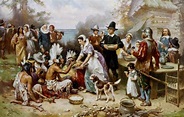
Thanksgiving Day is a national holiday in the United States, and Thanksgiving 2023 occurs on Thursday, November 23. In 1621, the Plymouth colonists from England and the Native American Wampanoag people shared an autumn harvest feast that is acknowledged as one of the first Thanksgiving celebrations in the colonies.
For more than two centuries, days of thanksgiving were celebrated by individual colonies and states. It wasn’t until 1863, in the midst of the Civil War, that President Abraham Lincoln proclaimed a national Thanksgiving Day to be held each November. But the holiday is not without controversy. Many Americans—including people of Native American ancestry—believe Thanksgiving celebrations mask the true history of oppression and bloodshed that underlies the relationship between European settlers and Native Americans.
For some scholars, the jury is still out on whether the feast at Plymouth really constituted the first Thanksgiving in the United States. Indeed, historians have recorded other ceremonies of thanks among European settlers in North America that predate the Pilgrims’ celebration.
In 1565, for instance, the Spanish explorer Pedro Menéndez de Avilé invited members of the local Timucua tribe to a dinner in St. Augustine, Florida, after holding a mass to thank God for his crew’s safe arrival. On December 4, 1619, when 38 British settlers reached a site known as Berkeley Hundred on the banks of Virginia’s James River, they read a proclamation designating the date as “a day of thanksgiving to Almighty God.”
 Cincinnati Gazette